Why Banks Are Hiring Again
Over the past several months, a noticeable shift has emerged across the New York metro and Hudson Valley banking landscape. Job postings for commercial lenders, credit analysts, portfolio managers, and credit officers have increased meaningfully — a sharp contrast to the cautious hiring environment of the past couple of years.
This is not coincidence. It is a signal!
After a prolonged period of uncertainty, banks are beginning to reposition themselves for growth. Understanding why this is happening provides valuable insight not only into the banking industry, but into where the broader credit cycle may be headed.
From Defensive Posture to Selective Growth
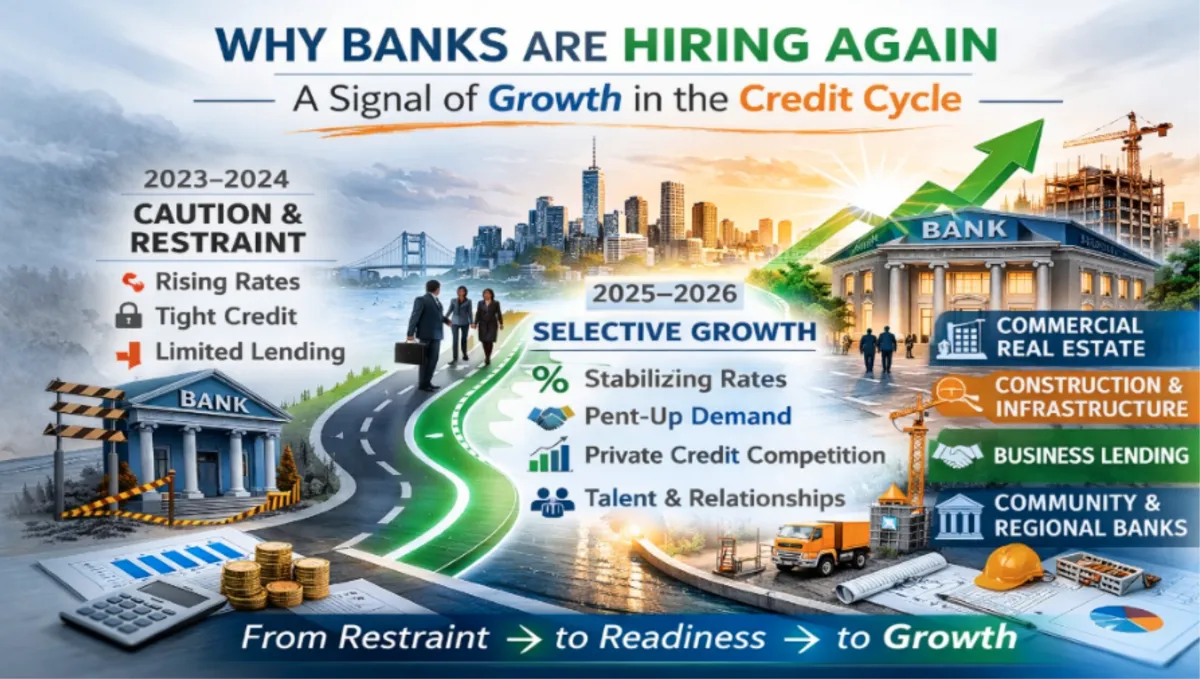
In 2023 and much of 2024, banks were in a defensive stance.
Rising interest rates, concerns over commercial real estate — particularly office exposure — and liquidity pressures following high-profile bank failures led many institutions to pull back. Hiring slowed. Credit standards tightened. Growth initiatives were paused.
Today, that posture is evolving. My inbox is inundated every day with messages from LinkedIn, Indeed and ZipRecruiter for job postings, a far cry from what I’ve seen just a few short months ago. What was once a sparse hiring environment has shifted to one where commercial banking roles are again in demand.
👉 This is not anecdotal — it’s real. A clear departure from last year’s “wait-and-see” environment.
My recent conversations with bankers across the region reveal a consistent theme: loan and deposit growth strengthened through 2025 and has carried into 2026. Many institutions are now facing capacity constraints—they have opportunity, but not enough experienced talent to fully capture it. Many cannot sufficiently meet this surge of lending activity without an influx of new talent – but where will that talent come from?
While banks remain disciplined, they are increasingly shifting toward selective growth, and hiring activity is one of the clearest indicators of that change. Welcome to the talent war in banking.
What’s Driving the Shift?
1. Stabilizing Interest Rates Are Unlocking Demand
As interest rates begin to stabilize, borrowers are regaining confidence. Deals that were shelved are being revisited:
Commercial real estate refinancings
Construction projects coming online
Owner-occupied acquisitions
Business expansion financing
2. Pent-Up Borrower Activity Is Re-Emerging
Banks do not expand lending teams without line of sight to future opportunity. Hiring is a forward-looking signal—an investment in anticipated loan demand, not a reaction to past performance.
Recent readings from the NFIB, ISM Manufacturing Index, and Federal Reserve regional surveys collectively point to a “cautious but constructive” outlook. While economic momentum is uneven and certain sectors—particularly manufacturing—have softened, there is little evidence at present of an imminent recession.
Within the New York metro market, key demand drivers remain intact. Multifamily housing continues to benefit from structural supply constraints, while medical office assets demonstrate resilience tied to demographic trends. Meanwhile, infrastructure and capital investment are fueling a steady flow of opportunities for contractors and developers—conditions that typically precede increased demand for commercial bank financing.
Over the past 18–24 months, many businesses delayed capital decisions. Now, those same businesses are re-engaging:
Contractors working through backlog
Developers recalibrating project economics
Business owners revisiting growth plans
This release of pent-up demand is creating renewed competition among banks for quality borrowers.
3. Competitive Pressure from Private Credit
While banks pulled back, private credit stepped in. Non-bank lenders expanded aggressively, offering speed and flexibility — often at higher pricing. As a result, banks lost some share of the middle market.
Today, banks are responding:
Reinvesting in relationship banking
Rebuilding commercial lending teams
Targeting stronger credits with disciplined structures
4. A Growing Shortage of Experienced Credit Talent
One of the less discussed — but most important — drivers is talent. There is a widening gap in experienced credit professionals:
Many senior lenders and experienced credit officers have retired or transitioned
Fewer younger professionals have deep underwriting training
This is especially true in areas such as:
Global cash flow analysis
Uniform Credit Analysis (UCA)
Contractor, CRE and construction lending
As a result, banks are not just hiring for growth — they are hiring to rebuild institutional credit knowledge.
Why This Is Especially Relevant in the Hudson Valley
The dynamics are even more pronounced locally. The New York metro and Hudson Valley region remain a solid bedrock of economic activity—among the most diverse and resilient markets in the nation. Banking in this region continues to be highly relationship-driven, with a strong concentration of:
• Community and regional banks
• Commercial real estate–focused lending
• Contractor, construction, and service-based businesses
In this environment, growth is inherently people-driven. Expanding a commercial portfolio requires experienced lenders and credit professionals who understand both the market and the borrower.
That makes talent—not just capital—a critical competitive advantage. Major institutions including JPMorgan Chase, Wells Fargo, Bank of America, Citibank, and M&T Bank have all been actively recruiting commercial lenders, credit officers, portfolio managers, and relationship managers across the New York metro region.
At the same time, regional and community banks are competing aggressively for the same talent pool, recognizing that market share gains are driven as much by experienced personnel as by balance sheet capacity.
What This Means for Business Owners
For borrowers, this shift creates opportunity — but also requires preparation. Banks may be hiring, but they are not lowering credit standards.
If anything, credit discipline remains firm:
Cash flow (DSCR and UCA) is still the primary driver
Leverage and liquidity continue to be key balance sheet metrics
Financial transparency and reporting quality matter more than ever
Loan structure and underwriting principles for CRE and construction projects remain well disciplined.
Borrowers with strong financial presentation, clear narratives, and well-prepared loan requests will benefit from increased competition among lenders.
What This Means for Banks
For banks, the challenge is twofold:
Capture growth opportunities in a competitive market
Maintain credit discipline in a still-uncertain environment
This balance will define performance over the next phase of the credit cycle.
Institutions that invest in both talent and training — particularly in credit underwriting — will be best positioned to succeed.
Final Thought
For those who understand how banks think, this moment offers clarity. Hiring trends are often one of the earliest indicators of strategic change in banking. The recent increase in commercial banking roles suggests that institutions are cautiously optimistic — positioning themselves for renewed lending activity while remaining mindful of risk.
In many ways, we are entering a transition phase: A potential turning point in the credit cycle.
From restraint… to readiness. Banks are preparing for growth, but they are doing so selectively.
At the same time, eyes remain wide open to geopolitical risks—particularly the conflict with Iran—and what a prolonged escalation could mean for energy markets, supply chains, and broader global economic stability.
For business owners, the message is simple:
Opportunity is returning — but preparation will determine access to capital and the quality of that capital and credit structure.
About the Author
John Kraus is the founder of Premier Credit Insights & Solutions LLC, providing advisory services to business owners, contractors, and real estate investors seeking to navigate commercial bank financing. With over 40 years of commercial banking experience, he helps clients become “loan-ready” and position themselves for successful lender relationships.