Inflation, Interest Rates and the Rising Cost of Capital - What It Means for Business Owners and Real Estate Investors
By John Kraus, Premier Credit Insights & Solutions LLC
Inflation and interest rates have once again become major concerns for business owners, commercial real estate investors, and lenders. While much of the public discussion focuses on inflation and Federal Reserve policy, a more consequential development may be unfolding: the rising cost of capital and its impact on business profitability, borrowing capacity, and real estate valuations.
After more than four decades in commercial banking, I've learned that economic cycles are inevitable. What matters most isn't predicting precisely when interest rates will rise or fall, but understanding how changing economic conditions affect cash flow, leverage, and access to credit.
Today, those relationships deserve particular attention.
Inflation: Slowing Prices Are Not Falling Prices
Inflation has moderated considerably from its 2022 peak of 8.0%, but it remains stubbornly above the Federal Reserve's long-term 2% objective.
According to the U.S. Bureau of Labor Statistics, September 2026 inflation increased to 3.7% annually, up from 3.4% in August. Core inflation, excluding food and energy, was 2.6%.
Energy prices contributed significantly to the September increase, with gasoline prices rising 9.1% during the month.
An important distinction is often overlooked: Lower inflation doesn't mean lower prices. It means prices are increasing more slowly.
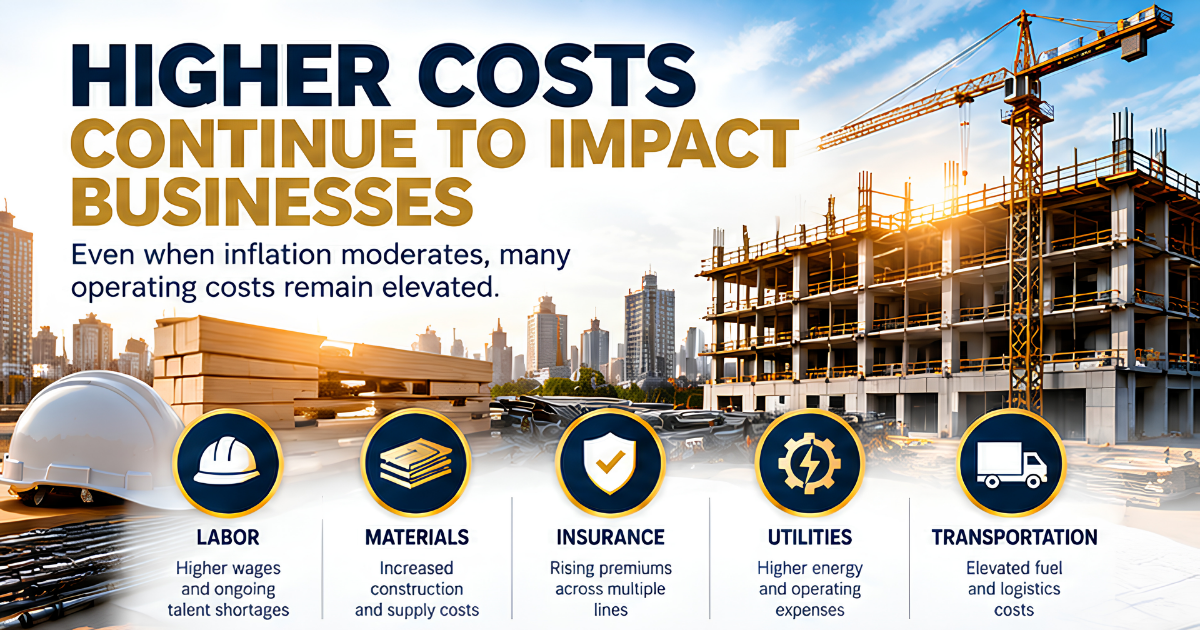
Businesses continue absorbing higher costs for labor, materials, insurance, utilities, and transportation. Even when inflation moderates, these expenses remain embedded in operating budgets.
For business owners, the consequences include pressure on profit margins, increased working capital requirements, and potentially greater borrowing needs. For builders and contractors, rising material and labor costs create additional challenges when estimating project costs and submitting competitive bids. Unanticipated cost increases during construction can quickly erode profit margins, particularly on fixed-price contracts.
For commercial lenders, the central question is whether revenues and cash flow are growing sufficiently to support those higher costs.
Interest Rates: Higher for Longer?
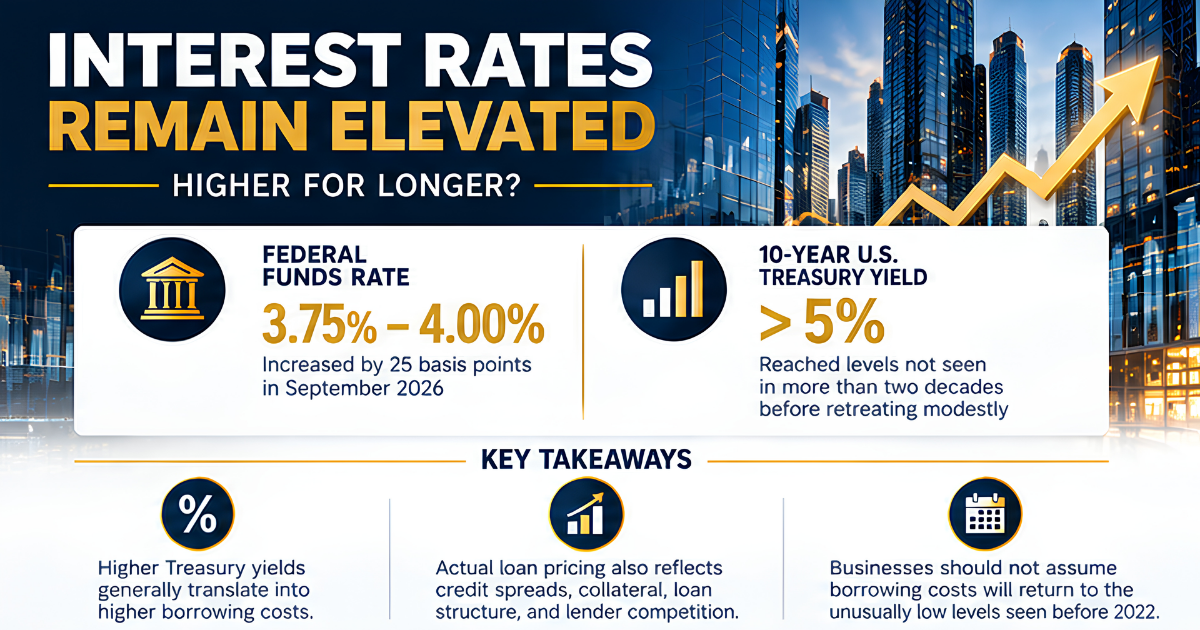
The interest-rate environment has become increasingly challenging. In September, the Federal Reserve increased its benchmark federal funds rate by 25 basis points to a range of 3.75%–4.00%, citing continued inflationary pressures. Meanwhile, the 10-year U.S. Treasury yield recently exceeded 5%, reaching levels not seen in more than two decades before retreating modestly.
Why is this important?
The 10-year Treasury serves as a key benchmark for longer-term commercial borrowing and real estate financing. Higher Treasury yields generally translate into higher borrowing costs, although actual loan pricing also reflects credit spreads, collateral, loan structure, and lender competition.
And while the Federal Reserve influences short-term interest rates, longer-term Treasury yields are driven by additional market forces, including inflation expectations, federal borrowing requirements, and investor demand.
The message: Businesses and investors should not assume that borrowing costs will return to the unusually low levels experienced before 2022.
Commercial Real Estate: A Growing Disconnect
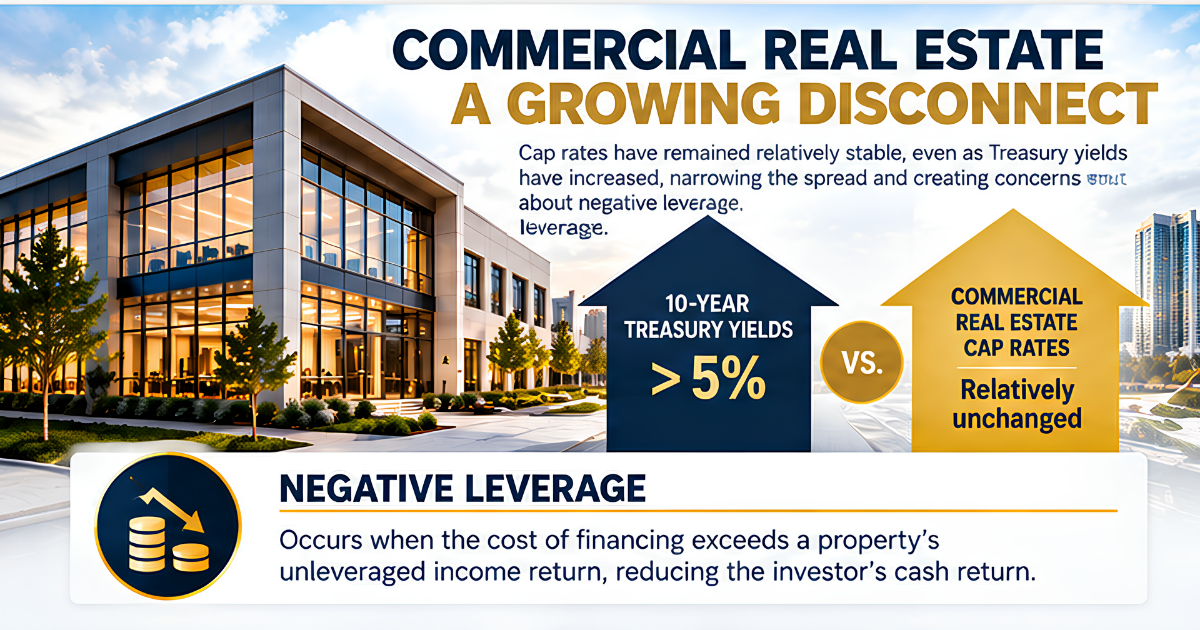
One of the more interesting developments is the relationship between Treasury yields and commercial real estate capitalization rates. Historically, investors have expected real estate cap rates to provide a reasonable premium over Treasury yields to compensate for the additional risks of property ownership. Yet according to CBRE's August 2026 Cap Rate Survey, average commercial real estate cap rates remained essentially unchanged during the first half of 2026, despite rising Treasury yields.
This has narrowed the spread between Treasury yields and real estate cap rates. It also creates another concern: negative leverage.
Negative leverage occurs when the cost of financing exceeds a property's unleveraged income return, reducing the investor's cash return on equity.
Consider a property purchased at a 6.5% capitalization rate, financed with a mortgage carrying a 7.25% interest rate. The investor is borrowing at a rate higher than the property's initial income yield. Unless net operating income increases, financing costs decline, or property values appreciate, the investment becomes less attractive. And when principal amortization is included, cash flow becomes even more constrained.
This raises an important question: Are commercial real estate values fully reflecting today's higher cost of capital?
I suspect not entirely.
The 2027 Refinancing Challenge
Another potential turning point is approaching.
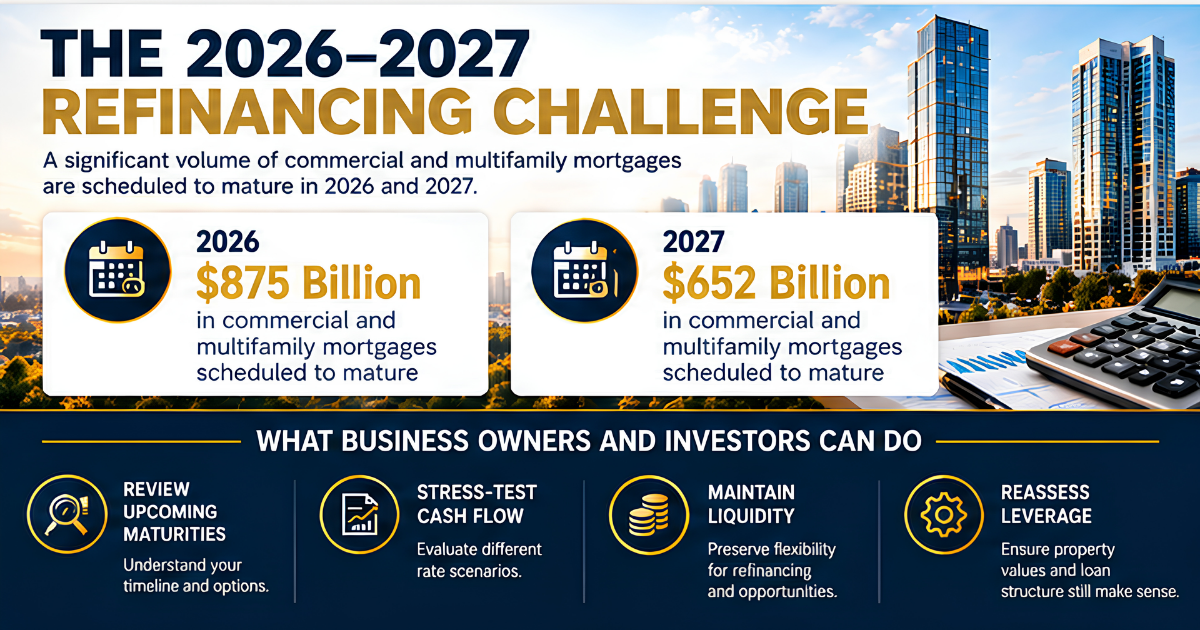
According to the Mortgage Bankers Association, approximately $875 billion in commercial and multifamily mortgages are scheduled to mature in 2026, followed by $652 billion in 2027. Many of these loans were originated when borrowing rates were considerably lower.
Consider a $7 million commercial mortgage originally financed at 4%, now facing refinancing at 7%. On an interest-only basis, annual debt service increases from $280,000 to $490,000—a $210,000 increase without any additional borrowing. If the refinancing lender requires principal amortization and a minimum debt service coverage ratio of 1.25x, the property's existing cash flow may no longer support the outstanding loan balance.
The borrower may be required to contribute additional equity, reduce the loan balance, or sell the property. If enough owners face similar circumstances, increased selling pressure could lead to declining property values and rising capitalization rates.
For illustration, a property generating $650,000 in annual net operating income is worth $10 million at a 6.5% cap rate. At a 7.5% cap rate, its indicated value falls to approximately $8.67 million—a 13.3% decline, even though income remains unchanged.
That is a meaningful adjustment for both investors and lenders.
Not every refinancing challenge will result in a distressed loan or forced sale. Many borrowers maintain substantial equity in their properties and generate sufficient cash flow to comfortably service their debt, even at today's elevated interest rates. These borrowers are well-positioned to refinance or negotiate favorable terms with their lenders without experiencing financial distress. For others facing tighter cash flow or refinancing shortfalls, lenders may offer extensions or restructuring arrangements. Nevertheless, the approaching wave of loan maturities, coupled with existing loans scheduled for interest-rate resets in the coming months, could accelerate the market's adjustment to higher financing costs, potentially placing upward pressure on capitalization rates and downward pressure on property values.
What Should Business Owners and Investors Do?
Review Upcoming Loan Maturities and Interest-Rate Resets. Borrowers with loans approaching maturity or scheduled for interest-rate adjustments should begin discussions with their lenders now rather than waiting until those dates arrive. Depending on market conditions and the borrower's financial strength, lenders may offer shorter-term rate commitments or loan modifications that provide temporary payment relief, potentially at lower rates than longer-term fixed-rate financing of five years or more. Other options may include adjusting amortization schedules or extending maturities to ease near-term cash flow pressures. With indications that interest rates may remain elevated for some time, borrowers should evaluate these alternatives early, preserve financial flexibility, and avoid being forced into unfavorable refinancing terms.
Whether you're operating a business, developing property, or managing an investment portfolio, I would emphasize four priorities:
Stress-test cash flow. Evaluate whether your business or investment can withstand borrowing rates 100–200 basis points above current levels.
Review upcoming loan maturities. Begin refinancing discussions well before maturity, particularly when additional equity or collateral may be required.
Protect liquidity. Higher operating costs and debt service can quickly consume working capital and cash reserves.
Reevaluate leverage and valuations. For real estate investors, consider how higher cap rates could affect collateral values and refinancing capacity.
The Banker's Takeaway
I believe the commercial credit market is entering an important period of adjustment.
Inflation remains elevated, long-term interest rates have risen, and the cost of capital is placing increasing pressure on business cash flow and commercial real estate valuations.
My expectation is not necessarily a widespread real estate downturn, but rather a prolonged period of selective repricing, more conservative lending, and greater scrutiny of borrower liquidity and repayment capacity.
The businesses and investors best positioned to navigate this environment will be those who recognize these challenges early and prepare accordingly.
The bottom line: Higher interest rates don't automatically create financial problems. Excessive leverage, insufficient cash flow, and inadequate planning do.
And that's why understanding your financial position through the eyes of a commercial lender has never been more important.
Think Like the Bank.